
The Definitive UK Guide to 3D, 4D, and Green Number Plate Legality: Avoiding Fines and Upgrading Safely in 2025.


Vehicle enthusiasts often overlook critical legal requirements when personalizing their cars. Understanding UK 3D 4D Green number plate legality is essential. They must balance the desire for modern, stylish number plates (such as 3D gel or 4D acrylic styles) against strict DVLA regulations. Consequently, failure to follow these rules results in significant legal and financial consequences.
Driving with an illegal number plate is a serious offense in the UK. Police can immediately seize the plate, and penalties include MOT test failure. Furthermore, the mandatory fine can reach up to £1,000. Therefore, verifying the legality of your plates is not optional; it is essential.
This comprehensive guide delivers the current and precise DVLA requirements for modern, personalized registration plates in the UK. It focuses specifically on the most popular trends in the market: 3D, 4D, and Green Flash plates. Understanding these standards allows motorists to upgrade their vehicle’s aesthetics with complete confidence and safety, as the information adheres strictly to the mandatory British Standard BS AU 145e.
The Core Standards: The Foundation of Legal UK Number Plates
Mandatory Requirements and Materials
Manufacturers must build all plates from a robust, retro reflective material. Front plates must display black characters on a white reflective background. Conversely, rear plates must show black characters on a yellow reflective background. Using non reflective materials or applying aftermarket films or tints is strictly illegal because it violates visibility standards and poses a safety risk in poor light.
The physical plate itself must carry specific legal markings to prove its origin and compliance. This includes a clear mark showing the name or trademark of the supplier who produced the plate. Critically, the plate must also display the current British Standard number, which is BS AU 145e for all plates fitted from September 1, 2021, onwards. For further details on these official standards, see the Official DVLA Guidance on Plate Markings .
The Charles Wright 2001 Font Rule
Legal number plates are restricted to only one approved typeface: Charles Wright 2001. The use of this specific font is crucial for recognition by law enforcement technology. It is absolutely prohibited to alter this font. This means styles like bold, italic, or cursive are illegal. Such modifications severely compromise the efficiency of OCR (Optical Character Recognition) systems, which Automatic Number Plate Recognition cameras use across the UK road network.
Precise Spacing and Dimensions
Compliance depends on minute details, particularly regarding character size and spacing. Even minor alterations designed to make a registration look better can lead to a fine. The following technical specifications are mandatory for standard rectangular UK registration plates for cars:
- Character Height: 79mm
- Character Width: 50mm (Excluding I/1)
- Character Stroke (Thickness): 14mm
- Standard Character Spacing: 11mm
- Age Identifier Gap (Centre): 33mm
- Minimum Margins (Top, Bottom, Side): 11mm
- Legality Marks: Supplier Name/Postcode & BS AU 145e
The minimum height of a standard 7 digit registration plate is 101mm, and the width is 460mm, accounting for margins and character sizes. While the industry standard plate size is 520x111mm, the strict sizing of the characters and the exact spaces between them define the legality of your UK number plate.
Motorcycle and Tricycle Variations
Motorcycles and motor tricycles require a smaller format to fit restricted mounting space. Vehicles registered after September 1, 2001, must only display a number plate at the rear, typically utilising a two line format. The character height must be 64mm, and the character stroke width must be 10mm. Furthermore, the standard space between characters is 10mm, and the space between the age identifier group and the random letters must be 30mm.
Deep Dive: Ensuring 3D and 4D Number Plate Legality
The legality of custom styled plates, such as 3D and 4D designs, is one of the most frequently searched queries by prospective customers. The definitive answer is clear: 3D and 4D number plates are fully road legal in the UK. However, they must be manufactured and displayed in strict adherence to the BS AU 145e legislative requirements.
Distinguishing 3D and 4D Styles
The terms 3D and 4D refer to different manufacturing processes. Both result in a raised character appearance.
- 3D Gel Plates: These plates feature characters coated with a polyurethane resin. This creates a high domed, slightly curved, glossy finish. They provide a distinctive, raised effect that complies with visibility rules.
- 4D Acrylic Plates: Manufacturers create these by laser cutting separate, solid acrylic characters (usually 3mm or 5mm thick). They then securely bond these characters to the reflective plate background. This process provides a highly defined, three dimensional look.
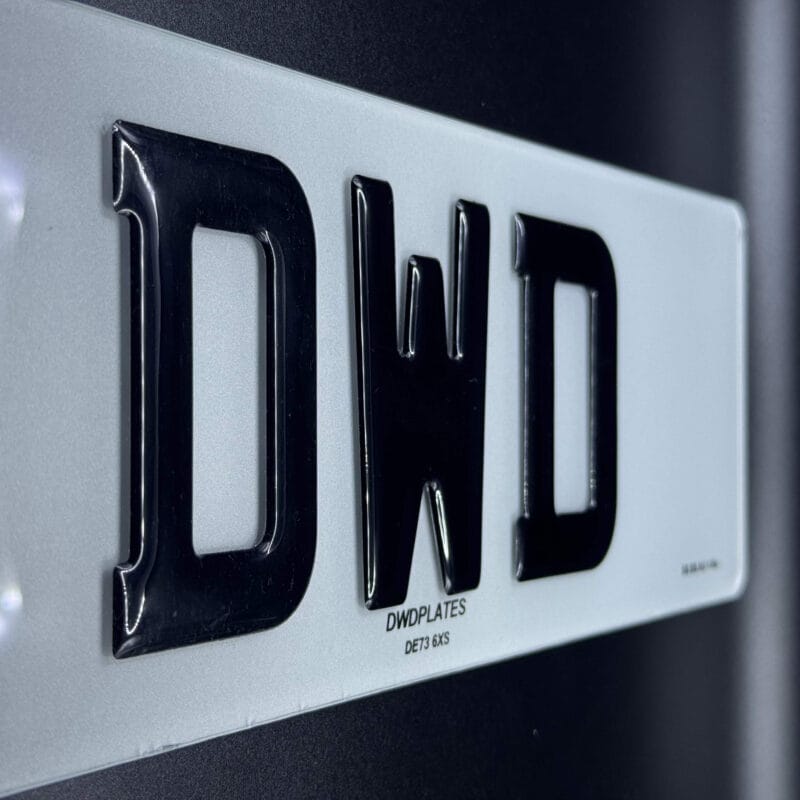
3D Number Plates
The Critical Compliance Point for Raised Characters
The legality of raised characters hinges on their ability to meet all technical standards, particularly those concerning visibility and integrity under the BS AU 145e standard.
- Non Removable Characters: The raised letters or numbers must be durably and permanently fixed to the plate. This prevents malicious removal or detachment due to weathering.
- Single Shade of Black: For all plates fitted after September 1, 2021, the characters must be a single, solid shade of black. Any dual tone, reflective, carbon fibre, or highly tinted finish on the character itself is illegal because it compromises ANPR readability.
- Correct Dimensions Maintained: Even with the added depth, the character’s width, height (79mm), and spacing (11mm/33mm) must remain precisely as mandated by law. Notably, illegal suppliers often err by applying the raised characters with incorrect spacing or incorrect font derivatives. This action makes the plate non compliant and liable for a fine.
Reputable manufacturers take an extra step to mitigate user risk: they ensure that the registration is permanently printed underneath the raised acrylic or gel characters. This guarantees the number plate remains road legal, even if a raised character were to detach, saving the driver from potential fines or MOT issues.
Driving the Future: Rules for Green Flash EV Plates
Green number plates represent a critical part of the government’s “Road to Zero” strategy. Their purpose is to visibly signal vehicles with zero emission status. They also potentially grant drivers access to local EV perks, such as certain clean air zones or specialized parking.
Strict Eligibility Requirements for Green Plates
It is important to clarify that strict criteria define eligibility for green plates. You can only use these plates for vehicles that produce zero tailpipe emissions.
This criterion primarily includes two vehicle types: Fully Electric Vehicles (EVs) and Hydrogen Fuel Cell Vehicles. A frequent misunderstanding in the market is whether standard hybrid vehicles qualify. They do not. Hybrid and conventional internal combustion engine cars must retain the standard plate design.
Design and Placement of the Green Flash
The green plate is legally identical to a standard number plate in terms of font, size, and reflectivity specifications. The only difference is the integration of a bold green vertical sliver, or ‘flash,’ positioned on the left hand side of the plate. This design often mirrors the placement of the blue European Union stripe, providing unique visibility to zero emission vehicles.
It should be noted that the adoption of the green flash is not mandatory for eligible vehicles. The decision to apply the new registration plate remains at the discretion of the vehicle owner or dealership.
The Pitfalls: Common Mistakes Leading to a £1,000 Fine
The risk of receiving a significant fine often stems not from deliberate illegal acts, but from common personalization mistakes. These errors violate the specific dimensional rules designed for ANPR compatibility. Understanding these common errors can save thousands of drivers from penalties.
Mistake 1: Mis Spacing or Altering Characters
This represents the single most frequent reason for police intervention and fines related to number plates. The law requires that the characters are displayed exactly as they are registered, with no rearrangement or alteration.
Specifically, any attempt to narrow the 11mm standard spacing or the 33mm centre gap constitutes an illegal modification. People often do this to make the registration appear to spell out a name or word. The legal solution is to purchase a legitimately spaced private registration. If you want to find out more about purchasing private plates, check our Ultimate Guide to Cherished Registrations.
Mistake 2: Tinted, Non Reflective, or Patterned Plates
Number plates must maintain high readability standards in all lighting conditions. The use of tinted materials, non reflective backgrounds, or custom background patterns is strictly illegal.
UK law mandates that manufacturers must make the plate from reflective material. It must display solid black characters on a clear white (front) or yellow (rear) reflective background. Tinted plates fail to meet these readability standards, leading to a police fine of £100 on the spot. Repeated offences will escalate the penalty.
Mistake 3: Incorrect Font and Sizing
While 3D and 4D plates are legal, they must still use the correct Charles Wright 2001 font outline and exact character dimensions (79mm high, 14mm stroke width). Any customised font styles—even aesthetically pleasing ones that slightly deviate from the required dimensions—are considered non compliant. This non compliance can result in an MOT failure and police fine.
The 2025 Registration Series & Modern Trends
Staying current with registration trends offers natural purchasing opportunities. The year 2025 is significant because it introduces two new age identifiers that will drive current style number plate sales.
The “25 Series” registration identifier is issued on brand new vehicles registered from March 1, 2025. This creates immediate transactional interest as motorists seek to personalize these new vehicles. The subsequent launch of the “75 Series” identifier occurs from September 1, 2025. Sales for this series often become available as early as May 7, 2025.
These new series allow for creative personalization, transforming standard plates into memorable registrations. Beyond current style plates, the market for cherished numbers remains robust. Dateless plates, issued before 1963, are especially valuable because they do not reveal the vehicle’s age. Consequently, they are highly sought after and often command premium prices.
Conclusion: Compliance and Customization, Upgrade with Confidence
The ability to customise a vehicle with 3D, 4D, or Green Flash plates is fully compatible with UK law, provided the core regulatory requirements are met. A legal plate is simply one that adheres strictly to the detailed specifications of the British Standard BS AU 145e. Compliance is non negotiable, given the steep penalty of an up to £1,000 fine for non conformance. Motorists can confidently combine style with statutory road legality by purchasing plates exclusively from certified suppliers who guarantee adherence to the exact font, spacing, material, and marking rules.
Stop Worrying, Start Customizing!
Design Your Guaranteed Legal, MOT Compliant Plate Now.
